
New fire safety regulations for all holiday homes 2023
As you’ve probably heard in the press recently, the new government fire safety regulations in England’s holiday accommodation kicks in soon.
Full-length, written assessments covering all aspects of fire risk will now be a legal requirement from the 1st of October, 2023. These changes aim to ensure that all holiday lets act safely and provide fire safety, making guests as safe as possible during their stay.
Sadly, these FRA are now much more in-depth than we could ever assist you with, and so, if we have helped you with one in the past, we need to ask that you pull the old version out of your welcome folder and look to replace it with the new one ASAP. Any previous to these new regulations will no longer be legal or meet insurance criteria.
We’ve put together some essential information to help make the transition a bit easier, as the regulations fall under two different categories:
- A single premises on the ground floor, or ground and first floor, providing sleeping accommodation for a maximum of 10 persons, with no more than four bedrooms on the first floor… or… ‘Individual flats (whether within a purpose-built block of flats or a house that has been converted into flats), other than unusually large flats.’ will most likely follow these guidelines: bit.ly/45QA2EU
- For any properties which are open plan (regardless of the number of bedrooms), or if your large property has four bedrooms or more or sleeps more than ten guests, then you’ll need to follow this guidance: bit.ly/3sQHNfq
What are the new guidelines?
- A fire Risk Assessment (FRA) must be conducted and recorded for your property. A copy of the Fire Risk Assessment should also be displayed on your property, ideally in your Cottage Information Folder.
- Emergency escape lighting is required in bedrooms and along the escape route – plug-in torches can provide this, although more significant properties may need full lighting. Borrowed light from, e.g. streetlights can be taken into account.
- Protected escape routes must have doors with a 30-minute fire protection capability or an adaptation that offers this level of protection.
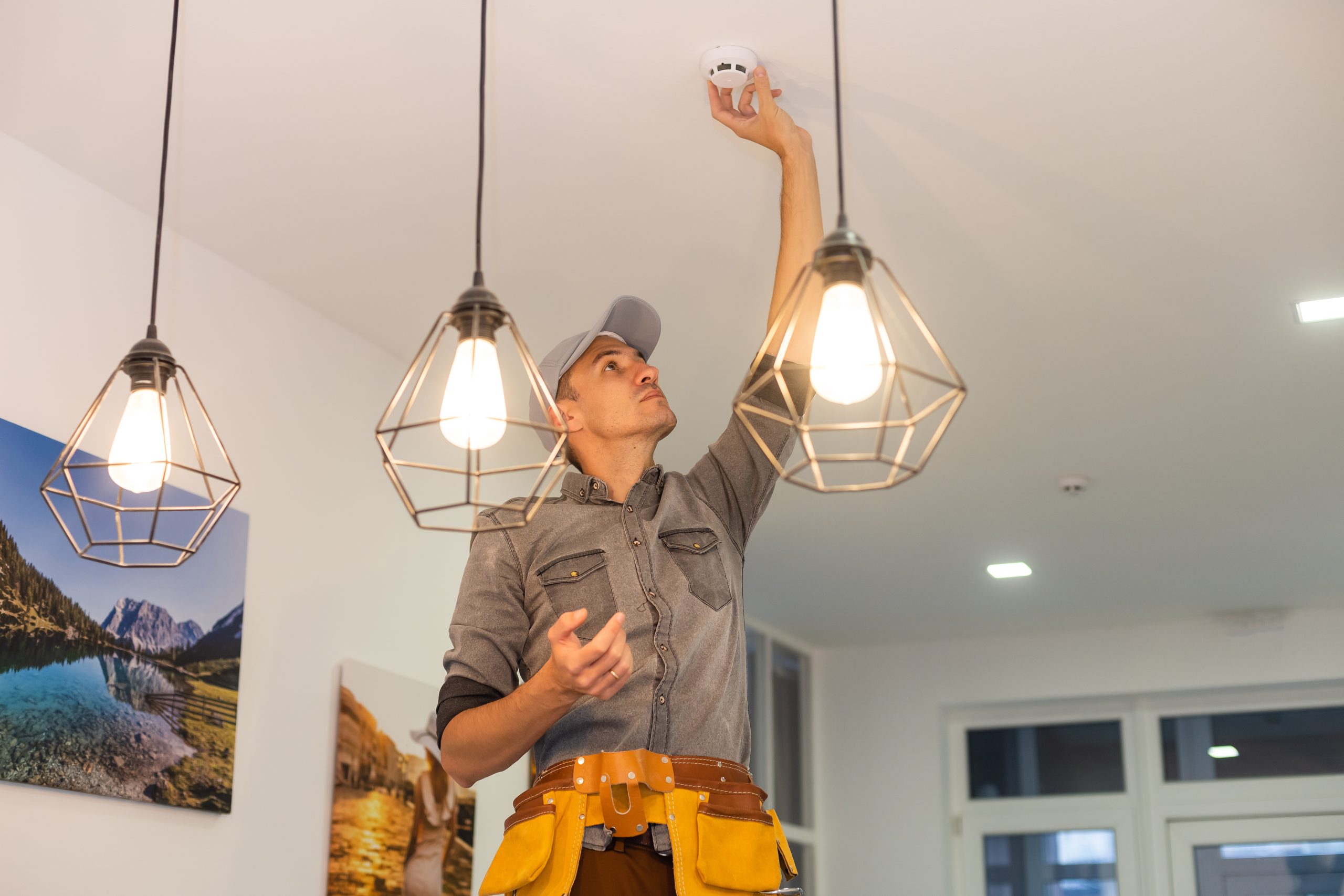
- Linked hard-wired smoke detectors are now required in all bedrooms and living rooms and protected escape routes, i.e. hallways, corridors, staircases, sitting rooms and dining rooms leading to the main fire exit. More significant properties or those with complex layouts may need more sophisticated detection systems.
- All hot water and heating systems must be inspected annually, including systems powered by renewable energy, e.g. air/ground source heat pumps.
- Thumb turn locks are now strongly recommended on all exit doors – There would be very few instances where it would be deemed unnecessary to fit these, and they can usually be retrofitted to most doors.
- The EICR (fixed wiring check) is required every five years, and this now also applies to many small Unique hideaways/glamping properties.
- Chimney flues should be swept annually.
- Checks on all fire safety equipment and exit routes must be carried out at each change of occupancy/weekly, and the results must be recorded.
- Candles should be prohibited, and a clear policy is required for your guests.
- For larger and/or more complex properties, the document Fire Safety Risk Assessment: Sleeping Accommodation still applies, and it is likely to be reviewed in 2024.
We strongly recommend that this is carried out by a professional FRA company who will be entirely up to date with legislation and can demonstrate they have the competency required to consider all risks. For larger and more complex properties, it is doubtful that the average property owner will have sufficient experience to evaluate the level of risk thoroughly.
When finding a professional to conduct the Fire Risk Assessment at your property, the best place to start is search engines such as Google and looking for a ‘fire safety risk assessor.’
It is always worth checking that they’re an accredited assessor. You can use the following sites to find accredited assessors:
New fire FAQ'S
Kindly provided by PASC.
Should I allow candles in my holiday let?
Candles and tea lights are a common cause of fire and sometimes fatalities. The New England Guide (published March 2023) and the New Wales Guide (published July 2023) both state:
“You should not provide candles, tea lights or ethanol burners for use by guests, and there should be a policy in place prohibiting their use.”
In other words, you should not provide candles or tea lights and have a policy prohibiting their use, i.e., in your house rules or terms and conditions.
What are the rules around smoking?
There is a ban on smoking in public places. Self-catering short-term rental accommodation (holiday lets, flats, caravans) is not considered a public space. You retain the right to determine whether to allow smoking on your property or your premises.
According to the Home Office, smoking is the cause of more fatalities than any other source of fire in domestic premises. The new Home Office Fire Guide for England states that you should have a defined policy on smoking, which should include vaping materials and e-cigarettes; guests should ideally smoke outside, with suitable provisions. While the new fire guide for Wales uses identical wording, all the example Wales layouts suggest that there should be a “no smoking policy prohibiting smoking within the premises”.
If you allow people to smoke on your premises – such as in a courtyard or garden – you should make suitable provisions (ashtrays and bins for materials disposal).
What precautions should I take with cooking equipment?
Avoid deep-fat fryers unless they are thermostatically controlled. Microwaves are also a potential source of fires. You should ensure that any cooking equipment is maintained and cleaned in good working order. Any gas appliances should be serviced annually by a registered gas-safe engineer. You should have a heat alarm in any area where cooking or food heating of any type is likely to occur, even where there is no proper kitchen.
Should I allow portable heaters? And portable AC units?
Portable heaters and AC units should only be used in exceptional circumstances, e.g. when main heating breaks down or in exceptional heatwaves. They should be fixed to the wall to avoid contact with combustible materials such as bedding and furnishings.
They should be tested as part of any electrical PAT annual programme. Your T&Cs should state that guest heaters and AC units must not be brought into the premises. Insurers often prohibit such portable appliances, so you may invalidate your insurance if they are present.
Should I provide fire blankets?
Fire blankets can be used by a person to protect themselves while exiting the premises where there is a fire or to put out a fire where a person’s clothes have caught fire. While the England guidance requires fire blankets, the Wales guidance does not require any ‘firefighting equipment’ in self-catering accommodation with no staff present. But we think that a fire blanket should be provided, not for firefighting, but for personal protection while exiting a building.
Do I need to provide fire extinguishers? What types of fire extinguishers are acceptable?
Fire extinguishers are not mandatory in England, except in static caravans and similar. Some fire services prefer self-catering premises not to provide fire extinguishers in premises without staff present, as guests are generally not trained to use them. They would prefer guests to exit the building immediately rather than attempt to fight a fire.
The new Home Office ‘Guide’, for smaller premises in England mentions fire extinguishers but does not make them mandatory. However it does state that if fire extinguishers are present, they should not be of the powder type, which is not considered suitable for self-catering environments. If provided, extinguishers should be multi-purpose, non-powder.
The new Wales guidance states that no firefighting equipment (extinguishers or fire blankets) is expected in self-catering accommodation where staff are absent.
Do furniture and furnishings need to be fire-compliant?
Regulations on furnishings were introduced in 1988, the Furnishings (Fire) Safety Regulations 1988. These cover new and second-hand furniture.
Your upholstered furniture must comply with these regulations if manufactured after 1 January 1950. Hard furniture such as tables does not need to comply, but upholstered items such as sofas, beds, beds and pillows must comply. Certain items are excluded, e.g. curtains, carpets, bedclothes.
Upholstered furniture manufactured before 1950 does not need to comply with the regulations and can also be renovated, e.g. reupholstered, without needing to comply.
Does the electrical system need to be regularly checked and tested?
You need to have your electrical system regularly checked. A qualified electrician can test your system and provide you with an Electrical Installation Condition Report (EICR). This should be done every five years. The report will highlight any measures that you need to take. Your electrician can also undertake a PAT of all your portable electrical equipment: toaster, hairdryers, lamps and so on. This should be done every one to two years.
You should also carry out regular checks at changeovers, such as checking cables for fraying or checking for damaged sockets or plugs, and you need to address any issues arising immediately.